
Spring Scholarship Symposium and Poster Session 2025
Spring Scholarship Symposium and Poster Session 2025
The Office of Academic Affairs and the Faculty Development Committee cordially invite you to join us for the Scholarship Symposium and Poster Session.
Thursday, May 15, 2025
From 9:00am to 3:00pm
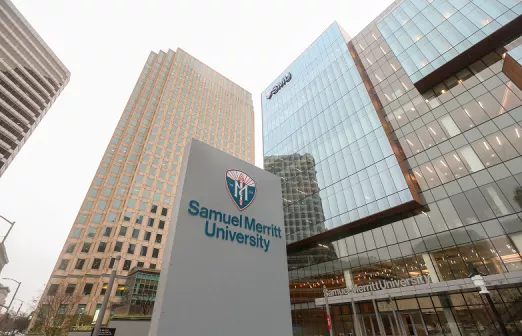
Samuel Merritt University
Bechtel Room - HEC
The 2025 Symposium will feature in person podium presentations with a Zoom broadcast.
Program
9:00 — Opening and announcements, FDC Co-Chair, Catherine Tanner
9:10 — Welcome, Provost, Brian Clocksin
9:20 — 11:45 Podium presentations (See accordions for times and details.)
12:00 — 1:00 Lunch (provided to RSVP’d attendees)
1:00 — 3:00 Poster Session
1:10 — 1:15 Centering event
1:15 — 1:20 Introduction to Poster Session
1:20 — 1:30 One-Minute Poster-Slams
1:30 — 2:45 Poster Session
2:45 — Closing Remarks
3:00 — Transition to Faculty Org
See accordions for CEUs sign in/sign out, survey link, and poster presentation details.
Continuing Education Units and Symposium Survey
Continuing Education Units
The Faculty Development Committee is pleased to offer CEUs to occupational therapy and nursing professionals. If you wish to receive CEUs for attendance at the Scholarship Symposium and Poster Session 2025, please complete the “sign in” and “sign out” surveys for your profession. Your certificates will be emailed to you within 4 weeks after the event.
Approved by the California Board of Registered Nursing, Provider Number 11258, for 2 contact hours. Attendance at this event is free of charge.
Complete the 2025 Scholarship Symposium Survey.
(1) 9:30 — Integrating Artificial Intelligence into Physical Therapy Education: Enhancing Clinical Decision-Making and Home Exercise Tracking for MSK Patients
Scholarship of Teaching and Learning — In Progress
Title: Integrating Artificial Intelligence into Physical Therapy Education: Enhancing Clinical Decision-Making and Home Exercise Tracking for MSK Patients
Author(s):
- Dr. Hoda Salsabili, PT, PhDs, Assistant Professor, Physical Therapy Department, College of Health Sciences, Samuel Merritt University
Learning Outcomes:
- Developing Patient-Centered Care Plans with Objective Data
Using AI in performance tracking, students can create well-rounded, patient-centered care plans that combine traditional clinical assessments with AI-driven insights. This practice helps them bridge subjective evaluations and objective technological inputs, enhancing patient outcomes.
- Enhance Critical Thinking Skills in Clinical Decision-Making
The AI platform’s data-driven assessments foster a richer clinical decision-making process. Students can make more accurate evaluations by monitoring aspects like gait and balance at home, leaving complex assessments for in-person visits. They’ll learn to refine care plans in response to patients’ needs, leveraging technology to support individualized patient care.
- Enhancing Patient Adherence and Motivation
The AI platform's tracking capabilities offer a clear view of patient progress, helping students understand the role of motivation and engagement in rehabilitation. AI’s real-time monitoring promotes adherence by keeping patients connected to their care plans, boosting motivation and supporting them through each phase of their rehab journey.
(2) 9:45 — Artificial Intelligence Versus Traditional Methods in Designing Curriculum for Pre-Licensure Medical-Surgical Nursing
Scholarship of Discovery/ Teaching and Learning — Completed
Title: Artificial Intelligence Versus Traditional Methods in Designing Curriculum for Pre-Licensure Medical-Surgical Nursing
Author(s):
- *Nadine Pruitt, DNP, MSN, PHN, RN, Assistant Professor, ABSN Program, College of Nursing, Samuel Merritt University
- *Annemarie Marchi, MSN, PHN, RN, Assistant Professor, ABSN Program, College of Nursing, Samuel Merritt University
- *Zahra Naderi-Asiabar, DNP, FNP, MSN, RN, Assistant Professor, ABSN Program, College of Nursing, Samuel Merritt University
- *Tammy Valenta, DNP, FNP, PHN, RN, Assistant Professor, BSN Program, College of Nursing, Samuel Merritt University
- Michele Santilhano, DNP, BSN, RN, Assistant Professor, ABSN Program, College of Nursing, Samuel Merritt University
Learning Outcomes:
- Implement artificial intelligence (AI) software to aid in the development of curriculum and produce reliable results to align the AACN new essentials, concept-based education, sub-competencies, domains, Course Learning Outcomes (CLOs) and course descriptions. Produce new or original work using artificial intelligence (AI) to create course activities, case studies and simulations that align with the CLOs, and the AACN concept- based education.
- Recognize the difference between AI and traditional methods in curriculum development in the pre-licensure nursing program.
(3) 10:00 — The Impact of a Stalking Awareness Workshop
Scholarship of Application and Service- In progress
Title: The Impact of a Stalking Awareness Workshop
Author(s):
- Jeneva Gularte-Rinaldo, PhD, RN, College of Nursing, Samuel Merritt University*
Learning Outcome(s):
- At the conclusion of this session, participants will be able to describe the impact of this stalking awareness workshop on student knowledge and confidence to recognize stalking behaviors as a healthcare professional (HCP) trainee.
(4) 10:15 — Elevating Student Voices: A Strategy to Enhance Engagement, Build Confidence, and Foster Program Excellence
Scholarship of Teaching and Learning – In progress
Title: Elevating Student Voices: A Strategy to Enhance Engagement, Build Confidence, and Foster Program Excellence
Authors:
- Shelitha Campbell, DNP, MSN, BSN, APRN, FNP-BC, HMCT, Assistant Professor, Collage of Nursing, Samuel Merritt University
- Cynthia Stacy, DNP, MSN, RN, Assistant Professor, College of Nursing, Samuel Merritt University
- Marcus Penn, MD, CYT
Learning Outcome(s):
- Strategies to engage/embrace difference within the academic and clinic environment to enhance student and program excellence and improve health outcomes
(5) 10:30 — Semi-Natural Environmental Conditions Influence Stress Reactivity and Behavior in Adult Female Rats
Scholarship of Discovery — Completed
Title: Semi-Natural Environmental Conditions Influence Stress Reactivity and Behavior in Adult Female Rats
Author(s):
- *Lisa Margerum, Assistant Professor, Basic Sciences, Samuel Merritt University
- Darlene Francis Associate Professor, School of Public Health. University of California, Berkeley
Learning Outcome(s):
- Learners will be able to describe how environmental complexity alters HPA axis activity and identify the physiological differences in stress responses between rats raised in laboratory versus semi-natural conditions.
- Learners will be able to explain the relationship between early-life maternal care and adult stress physiology, and critically assess how environmental enrichment or stress may interact with or override these developmental influences.
(6) 10:45 — Artificial intelligence Virtual Simulated Patients (AI-VSP) helping medical students improve history taking skills
Scholarship of Teaching and Learning — Completed
Title: Artificial intelligence Virtual Simulated Patients (AI-VSP) helping medical students improve history taking skills
Author(s):
- Mohammad Kabakibi, BS, Volunteer, Azzam Research Group
- Lucas Lopes, MD, Volunteer, Azzam Research Group
- Mariana Berwerth Pereira MD, Volunteer, Azzam Research Group
- Sara Turkstra, BSN, Volunteer, Azzam Research Group
- Saba Zehtabi, MD, Volunteer, Azzam Research Group
- Nodana Gautam, MBBS, Volunteer, Azzam Research Group
- Yara Shhab, MD, Volunteer, Azzam Research Group
- Elizabeth Kouch, BA; Volunteer, Azzam Research Group
- Chad S. Miller, MD, FACP, SFHM, Senior Associate Dean of Undergraduate Medical Education, St. Louis School of Medicine
Amin Azzam, MD, MA, Professor, HSSC, Samuel Merritt University*
Learning Outcome(s):
- Understand the concept of Artificial Intelligence Virtual Standardized Patients (AI-VSP) as a simulation-based learning tool.
- Through results of the use of AI-VSP at one medical school, consider applications for one’s own SMU course and/or student populations.
(7) 11:00 — Bridging the Language Gap Among Healthcare Students Through Open Educational Pedagogy
Scholarship of Teaching and Learning, Scholarship of Application/ Service — In progress
Title: Bridging the Language Gap Among Healthcare Students Through Open Educational Pedagogy
Author(s):
- Perla Nafeh; B.S. student; Biological Sciences; School of Arts and Sciences; Lebanese American University
- Mohammad Kabakibi, BS, Department of Natural Sciences, Lebanese American University
- Asher Freund, A.B. summa cum laude, Department of English, Amherst College
- Amin Azzam, MD, MA*, Health Sciences Simulation Center, Samuel Merritt University
Learning Outcome(s):
- Understand Open Educational Pedagogy (OEP) as a teaching and learning strategy to develop Open Educational Resources (OER).
- Understand the collaboration between Chain of Education, Osmosis by Elsevier, and volunteer health professional students captioning videos on a YouTube health education channel into Arabic.
8) 11:15 — Integrating Generative AI into New MSN Program Development for Faculty and Student Success
Scholarship of Teaching and Learning — Completed
Title: Integrating Generative AI into New MSN Program Development for Faculty and Student Success
Authors:
- Liz Winer, MA, Senior Instructional Designer, Dept. of Academic & Instructional Innovation, Samuel Merritt University*
- Elmarie Botha, Co-Director MSN Executive Leadership program, Assistant Professor, College of Nursing, Samuel Merritt University*
- Laurie Rosa, DNP, RN, Co-Director MSN-EL program, Assistant Professor, College of Nursing, Samuel Merritt University*
Learning Outcome(s):
- Describe how generative AI program policies, AI-resistant assignments, and guided use of AI can be folded into new program creation or program revision.
(9) 11:30 — SMU Students’ Perceptions and Use of Generative AI
Scholarship or Teaching and Learning, Scholarship or Application/Service — In Progress
Title: SMU Students’ Perceptions and Use of Generative AI
Author(s):
- Liz Winer, MA, Senior Instructional Designer, Dept. of Academic & Instructional Innovation, Samuel Merritt University*
- Rhea Kimpo, PhD, Associate Professor, Dept. of Basic Sciences, Samuel Merritt University
Learning Outcome(s):
- Describe the current landscape of Generative AI perceptions of and use by SMU students.
- Describe factors that influence SMU students’ use and perceptions of Generative AI.