
Health Sciences Simulation Center
Build the skills and confidence to care for patients. At Samuel Merritt University, students practice in realistic healthcare environments where they can make decisions and learn from experience before entering patient care.
Real-World Learning Through Simulation
The Health Sciences Simulation Center (HSSC) is one of the West’s most advanced healthcare simulation facilities and an integral part of education across Samuel Merritt University. High-quality immersive simulation learning is integrated across SMU programs and campuses.
Students apply what they learn in the classroom in realistic healthcare environments before they are expected to perform those skills independently in clinical practice. They practice technical skills, make decisions about patient care, and learn to work effectively with other healthcare professionals.
Just as importantly, the Simulation Center provides a supportive and psychologically safe environment where students have permission to ask questions, make mistakes, reflect on what happened, and try again. As students progress through their programs, simulation experiences become increasingly complex, helping them build the judgment and confidence they will need to care for patients.
Simulation-based learning gives students opportunities to:
- Apply classroom learning in realistic patient-care situations
- Practice technical and clinical skills before using them in clinical settings
- Strengthen clinical judgment and decision-making
- Develop communication and teamwork skills
- Learn with students from other healthcare disciplines
- Receive immediate feedback through guided debriefing and reflection
In partnership with SMU’s Center for Community Engagement, HSSC also creates simulation experiences that address social drivers of health, community health challenges, and emerging public health concerns. Working alongside SMU's diverse student body, students prepare to provide trauma-informed, culturally responsive care to people from diverse backgrounds and communities.
The HSSC is internationally recognized and accredited by the Society for Simulation in Healthcare in Teaching and Education, Research, and Assessment.
Designed to Replicate Real Healthcare Environments
The Simulation Center uses flexible spaces, current medical equipment, advanced simulation technology, and trained simulated patients to recreate the situations students may encounter in practice. Simulation environments can replicate an emergency department, operating room, clinic, rehabilitation clinic, or home visit, preparing students to provide care in a range of healthcare settings.
Students work with a wide range of simulation resources, including:
- Realistic full-size adult, pediatric, and infant manikins
- Task trainers for practicing specific clinical skills
- Point-of-care ultrasound
- Medical equipment that reflects what students will encounter in clinical settings
- Virtual reality technology
- Live actors trained to portray patients, clients, and family members
More than 100 trained Simulated/Standardized Patients bring another level of realism to the experience, portraying not only physical symptoms but the stories, emotions, and communication challenges students may encounter in patient care.
At each SMU campus, HSSC clinical skills labs and simulation suites support simulation and technology-enhanced teaching. Students use the same types of equipment found in hospitals and other healthcare settings to practice skills such as inserting IVs, giving injections, and performing head-to-toe health assessments.
Simulation Facilities Across SMU
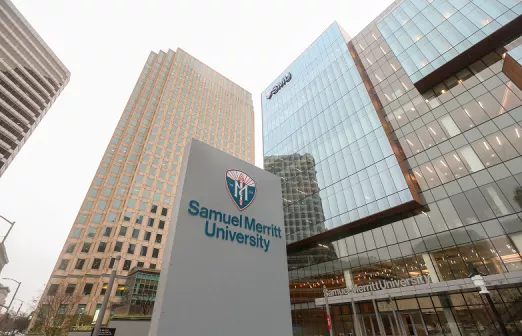
The Oakland campus includes approximately 40,000 square feet of simulation and clinical skills space, including:
- Eight hospital rooms
- Two dual-occupancy hospital rooms that can replicate operating rooms
- 16 clinic exam rooms
- Four skills training spaces
- Two simulated home health environments
- Piped oxygen
SMU’s regional campuses provide approximately 6,000 square feet of additional simulation and clinical skills space, including:
- Two hospital rooms
- Two clinic exam rooms
- One clinic procedural room
These flexible spaces allow HSSC to create realistic emergency department, operating room, clinic, rehabilitation, and home-health environments across SMU campuses.
Interprofessional Practice and Education
Simulation-based learning enhances interprofessional practice and education (IPE) by giving students opportunities to work with other health professions in realistic patient-care situations.
Students learn with, from, and about other health professions as they work together to provide person-centered care. These hands-on experiences help students connect what they learn within their own disciplines to the collaboration required in complex healthcare systems.
Each scenario is followed by a guided debriefing with faculty trained in interprofessional education. HSSC educators work directly with IPE teams and academic faculty to integrate these experiences into the curriculum.
Students and professionals from UC Berkeley, UC San Francisco, Cal State East Bay, San José State, San Francisco State, and John F. Kennedy universities have also participated in these IPE experiences.
More information on IPE at SMU
Mission, Values & Principles
The HSSC Mission:
The HSSC promotes immersive learning for healthcare professionals in an environment where simulation-based education is purposefully integrated into programs. Through a collaborative, interprofessional approach, we provide opportunities to acquire knowledge based on best practices and to positively transform the experience of learning.
We Value:
- An environment where we challenge ourselves and our students to think critically, seek mastery, and act compassionately.
- A collegial environment where we are fair, respectful, and behave with integrity.
- A collaborative environment where we partner with one another and with others in the community.
- An innovative environment where we take reasoned risks and move nimbly.
- A results-oriented environment where we provide and expect exceptional performance and service.
HSSC Guiding Principles:
- Listening and collaborating is essential to our success.
- Limitless possibilities exist to create an immersive learning environment.
- People learn by actively engaging in an immersive, supportive, reflective, and structured environment.
- Learners include faculty, students, and healthcare professionals both internal and external to SMU.
- Everyone is a lifelong learner.
- All learners, faculty, and staff are treated equitably and respectfully regardless of their backgrounds and identities in accordance with SMU’s Principles of Community.
- There is personal responsibility for enhancing individual knowledge for teaching and learning practices.
- We have an obligation to contribute to the body of knowledge of immersive learning through research and scholarly dissemination.
- We are essential to successful Interprofessional Education at SMU.
- We believe in the TeamSTEPPS approach to working as a team.
Educational Priorities
- We emphasize human factors and patient safety in strengthening our core curriculum.
- We implement interprofessional scenarios that reflect real clinical situations, often using real cases as our models.
- We support SMU’s faculty members as they integrate simulation into SMU’s curriculum in all disciplines.
- We support the goal of simulation-based learning methodologies as SMU’s primary paradigm for demonstrating educational effectiveness.
- We develop structured courses on crisis resource management for targeted groups of community health professionals and all SMU students.
- We provide regional leadership and participate in regional training.

We Embrace Hands-On Learning
Expertise Behind the Experience
The Simulation Center's experienced faculty and staff include certified simulation educators and simulation operations specialists who work with faculty across SMU to design purposeful simulation experiences.
The team calls its approach “innovation with purpose.” Technology makes sophisticated simulation possible, but the people behind those experiences are what make the Center distinctive.
Interested in acting as a Simulated/Standardized Patient?
Let us know. A member of the HSSC team will contact you.
Inside the Simulation Center
Explore our state-of-the art learning facility.
Recent News
Recent News

Related Links
Contact
Need More Assistance?
Health Science Simulation Center
Rachel True
- Oakland
- -
- rtrue@samuelmerritt.edu
Health Science Simulation Center
Krista Anderson
- White Bear Lake
- kanderson1@samuelmerritt.edu
Health Science Simulation Center
Rachel True
- Oakland
- -
- rtrue@samuelmerritt.edu
Health Science Simulation Center
Amin Azzam
- Oakland
- 7359
- aazzam3@samuelmerritt.edu
Health Science Simulation Center
Caleb Jacobs
- Sacramento
- -
- cjacobs@samuelmerritt.edu
Health Science Simulation Center
Carlos Joy
- Oakland
- -
- cjoy@samuelmerritt.edu
Health Science Simulation Center
Chris Mendez
- Sacramento
- 916-678-3178
- cmendez@samuelmerritt.edu
Health Science Simulation Center
Lauren O'Niell
- Oakland
- 7361
- loniell@samuelmerritt.edu
Health Science Simulation Center
Sierra Marcum-Gonzalez
Health Science Simulation Center
Ben Avalos
- Oakland
- -
- bavalos@samuelmerritt.edu
Health Science Simulation Center
Greg Fortaleza
- Oakland
- -
- gfortaleza@samuelmerritt.edu
Simulation Technology Specialist (San Francisco Peninsula Campus)
Jenny Kinsel (she/her), BFA, CHSOS
Instructor (Fresno campus)
Alyssa Borgioli (she/her), MSN, RN, PHN
Instructor (Oakland campus)
Genevieve Charbonnea (she/her), EdD
Instructor (Oakland campus)
Lucinda Allen (she/her), MSN, RN, PHN, CMSRN
Instructor (Oakland campus)
Sylvia Ndusha (she/her), OTR/L
Simulation & Technical Services Technician (Fresno campus)