
Standing on Science

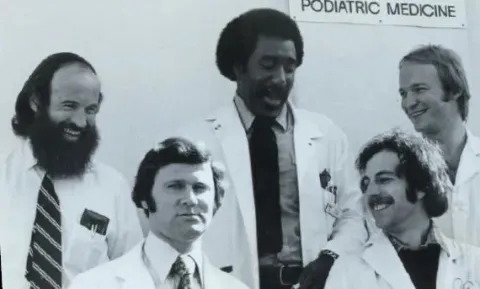
“I got into podiatry because I have such bad feet,” says Chris Smith, DPM ’63.
With feet “as flat as pancakes,” Smith, who taught for decades at the California College of Podiatric Medicine, the precursor to SMU’s College of Podiatric Medicine, started seeing a podiatrist when he was 14 years old. Thanks to prescribed orthotics, he was finally able to walk without discomfort and pain.
Though some two million Americans use shoe insole orthotics to relieve pain, correct alignment, and redistribute pressure, the scientific data on them is sparse. “I wanted some real research,” explains Smith. “There are articles about the mechanics of the foot, but nothing significant regarding the effects of orthotic devices on the feet and lower extremities.”
Smith is aiming to change that by funding a research project conducted by SMU Assistant Professor of Podiatric Medicine Tim Dutra, DPM ’85 — who took Smith’s classes in the early 1980s — and Associate Professor Stephen Hill, PhD. Dutra and Hill are overseeing an investigation and data collection of the biomechanical effects of wearing customized foot orthotics, all conducted in SMU’s Motion Analysis Research Center (MARC) located on SMU’s new Oakland campus.
“As a longtime California College of Podiatric Medicine faculty member, Dr. Smith was synonymous with the biomechanics lab, remembers Dutra, who’s been treating patients in sports medicine for decades. “And he’s continued to stay passionate about biomechanics and our podiatric curriculum and training. He loves talking about physics and motion of gait and movement.”and very passionate about both the field and about teaching,”
Putting Orthotics to the Test
Previous foot orthotics studies have lacked oversight by podiatrists and failed to control variables such as how different socks and shoes impact the orthotics. So Dutra and Hill brought in certified pedorthist Jenny Wong, who provided standardized socks and shoes from New Balance, another sponsor of the study. “Insoles are only as good as the shoes you put them in,” notes Dutra, an athlete who wears orthotics himself.
The 15 test subjects are second- and third-year podiatry students between the ages of 18 and 35. Hill and Dutra employed a state-of-the-art 3D foot scanner — called the “foot positioner” — to assess all types of feet and their needs using the foot posture index, a clinical tool that measures to what degree the foot is neutral, pronated (flat), or supinated (high arch). They seek to answer questions about how custom functional orthotics affect standing balance and how orthotics change the plantar pressures of the foot during the gait cycle, walking, and running.
For three weeks, students wore their custom-made orthotics inside New Balance shoes and then, during a session in the MARC, used sensors between the foot and the insole to effectively measure standing balance and treadmill walking foot pressure. Dutra predicts that the orthotics will be proven to shift the pressure in the foot the way he hopes.
“I can tell you empirically, after 40 years of doing this, that orthotics have been a very important part of my practice in thetreatment and prevention of injuries to the foot and lower extremity,” he explains. “I’ve treated patients of all ages in sports medicine, and less than a handful out of thousands said they didn’t help.”
This summer and fall, Dutra and Hill will assess and interpret the data they’ve collected, prepare conference presentations, and write up their findings. The hope is that once their theory has been proven objectively and their findings have been peer reviewed and published, then insurance companies, especially Medicare, will cover the cost of orthotics for patients. This is especially timely given that the fastest-growing population group is people 65 and up.
“We want to prove that orthotics help improve our gait and reduce injuries, and will save money in the long run,” says Dutra.
Dutra sees potential for this research to continue even after he retires later this year. Possible spin-off studies could look more closely at how custom orthotics could alleviate stress and strain on knee joints, thereby reducing the risk of very common ACL knee injuries.
A Lasting Footprint
Custom orthotics have come a long way since they were first prescribed to Smith back in the 1950s — thanks in large part to Smith himself. In the 1970s, he “applied all the knowledge” he’d gathered as a professor of podiatry and joined the Northwest Podiatric Laboratory in Washington, where he helped develop the prefabricated, ultra-thin orthotics called Superfeet, made with a combination of fiberglass and graphite and now widely considered the best overall insoles on the market. In fact, comedian Jerry Seinfeld was so impressed with his Superfeet orthotics that he befriended Smith and his wife, even including them in an episode of his beloved eponymous show.
“There was a time when I knew at least half the podiatrists on the West Coast. I would go to conventions and it was like a family reunion,” remembers Smith, who became a professor emeritus at SMU in 1991.
Despite these accolades, Smith says he’s “not a high-profile person,” and enjoys his quiet retired life that involves “more lying around and cogitating about the foot” than actually using his feet these days. Originally from British Columbia, Smith has lived in northwest Washington for decades — and his legacy lives on at SMU thanks to his groundbreaking expertise, impassioned teaching, and generosity.
As his former student Dutra puts it, “We always want our students to be better trained and more clinically competent than we are.” That’s something he learned from Smith.