SMU to Launch THRIVE Institute on Human Trafficking Response with $1 Million in State Funding Championed by Sen. Jesse Arreguín

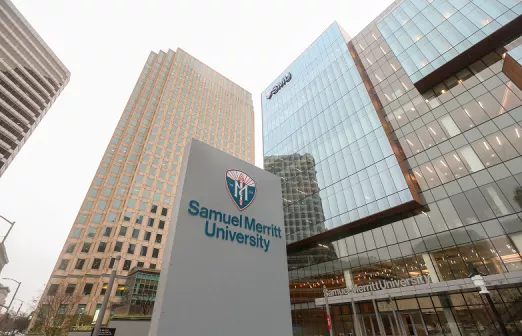
Samuel Merritt University (SMU) announced today $1 million in California state budget funding, championed by California state Sen. Jesse Arreguín, to create the SMU Trauma-Informed Health Education, Research and Innovation on Violence and Exploitation (THRIVE) Institute. The institute will train healthcare workers to recognize and respond to human trafficking and violence, and open new health career pathways for survivors. The same budget includes a separate $1 million for the City of Oakland's violence prevention work. Arreguín and Oakland Mayor Barbara Lee joined SMU at a press conference this morning at its downtown Oakland campus.
"The THRIVE Institute will help SMU prepare health professionals to recognize violence and exploitation and respond with trauma-informed care,” said Dr. Sam Alavi, director of SMU’s Center for Community Engagement and Ethnic Health Institute, which will house the new THRIVE Institute. “As a health sciences university rooted in Oakland, we don’t take our responsibility lightly. We want SMU to help set the standard for how universities prepare healthcare professionals to lead in this area and to do so in close partnership with survivors, local leaders, and community organizations."
The SMU THRIVE Institute will build on SMU's existing human trafficking prevention and response program, which has trained nearly 700 current and future healthcare professionals since 2022 in partnership with critical community organizations such as MISSSEY. MISSSEY is an Oakland-based organization nationally recognized for its survivor-informed expertise in addressing the commercial sexual exploitation of youth, which has provided invaluable technical training and guidance to SMU’s trafficking work. SMU’s training program teaches trauma-informed, survivor-centered care and uses SMU's simulation center for interprofessional training. It won the American Association of Colleges of Nursing's Innovations in Professional Nursing Education Award in 2024.
SMU’s human trafficking prevention and response efforts have been led by the Center for Community Engagement and Ethnic Health Institute, with collaborative leadership from faculty across the University, including Dr. Shelitha Campbell, Sarah Koster, Dr. Jeneva Gularte-Rinaldo, Dr. Nada Elias-Lambert, and Dr. DeAnne Larson, as well as the team at SMU’s Health Sciences Simulation Center (HSSC). Together, this interdisciplinary group has helped shape and deliver the education, simulation, and community-engaged work that now provides the foundation for the THRIVE Institute.
Training, Toolkits and Community Services
With its $1 million, SMU plans to establish the THRIVE Institute, which will:
- Open a training academy where healthcare workers across the region can earn continuing education in trafficking response and trauma-informed care
- Expand trafficking and trauma-informed care training for SMU students across all four campuses and disciplines
- Evaluate its programs and publish the findings, along with curriculum toolkits and assessment tools that other institutions can use
- Bring trauma-informed health services into the community through partnerships with clinics and survivor-serving organizations, including a master of social work fellowship that provides free behavioral health services
- Train community members who work on the front lines of violence response in burnout prevention and wellness
- Study and address the intersection of human trafficking and perinatal health
- Support prevention programs for East Bay youth on confidence, healthy relationships and consent, and build on SMU's scholarship for those impacted by sexual violence and trafficking
Over the next five years, SMU expects the institute to reach several thousand students, healthcare professionals, patients and community members through training, simulation, direct services and community programming. This work will be guided by and done in partnership with community experts and partners, including the city's Department of Violence Prevention.
"Most trafficking survivors see a healthcare worker while they are being trafficked, yet only about 30% of healthcare workers say they feel prepared to respond," said Sarah Koster, FNP, MSN, MPH, an assistant professor in SMU's College of Nursing. Koster helped launch SMU's trafficking education program several years ago after seeing the training gap firsthand while supervising nursing students in clinical placements. “I want our SMU students to graduate with the tools to be leaders in addressing trafficking in clinical spaces and beyond. This new institute gives us room to teach that."
Part of a Broader Investment in Oakland's Health and Safety
The other $1 million goes to the City of Oakland's Department of Violence Prevention.
The city plans to spend its $1 million on wellness and leadership development for crisis intervention workers, who engage the people closest to gun violence, and on job training through Cypress Mandela Training Center for people leaving cycles of violence.
"Samuel Merritt University has already proven this approach works, and that's why I championed to secure this funding," said Sen. Arreguín. "The THRIVE Institute can now scale it across the region and give other communities a model to follow."
"This funding supports the crisis intervention workers on the front lines of gun violence and creates job pathways for people leaving cycles of violence," said Oakland Mayor Barbara Lee. "Paired with SMU's THRIVE Institute, it shows that healing, opportunity and safety go hand in hand. I'm grateful to Senator Arreguín for championing both.”