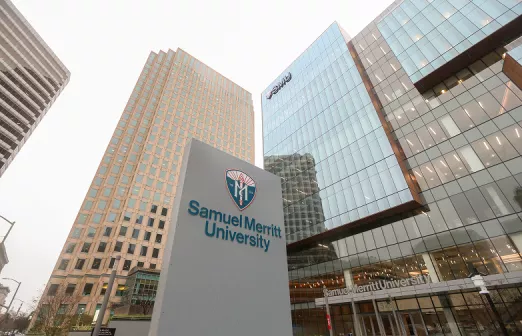
A Historic Walk Around the New SMU Oakland

If you were to walk along Oakland’s 12th Street in 1873, you’d be in awe of the Grand Central Hotel built by SMU’s namesake, Dr. Samuel Merritt. The city’s first major downtown hotel featured four stories, 240 rooms, and all the amenities expected of a first-class destination. Although it was destroyed by fire in 1880, the hotel symbolized the ambition and growth transforming Oakland during the late 19th century.
For more than 150 years since then, Samuel Merritt University’s new Oakland neighborhood — the 11 blocks stretching from West Oakland to Lake Merritt — has been making history and reinventing itself.
Around 1900, 12th Street was known as “Auto Row,” lined with car dealerships and repair shops, where shoppers could choose between a Studebaker electric vehicle or a gas-powered Ford Model T. Not long afterward, the street became Oakland’s Theater District, home to vaudeville houses and then movie palaces that drew crowds from across the city, making 12th Street an entertainment destination.
Education also left its mark on 12th Street. Henry Durant’s College of California merged with the state’s new land-grant college to form what became the University of California in 1868. As Oakland’s mayor and one of the university’s first regents, Merritt helped guide the institution and secure the Berkeley site where the university could expand.
Merritt’s impact also extended to changing the physical landscape of the neighborhood. In 1869, he funded a dam that transformed an odorous tidal mudflat known as Peralta Lake into today’s beautiful Lake Merritt. He also prohibited sewage from entering the lake and helped secure its designation as the nation’s first wildlife refuge.
SMU’s mission and spirit of service and compassion have deep roots around 12th Street. After the 1906 San Francisco earthquake, 150,000 refugees fled their destroyed city and arrived in Oakland by ferry. Churches, synagogues, businesses, and civic organizations, including the Oakland Relief Committee and the Oakland Chamber of Commerce, opened their doors and rallied volunteers who provided food, shelter, and assistance to people in crisis. One church alone served meals from 6:30 a.m. until midnight, feeding as many as 1,500 people each day that April.
Today, SMU students walking to class are stepping into a neighborhood shaped by innovation, education, public service, and community care — values that have defined both Oakland and SMU for generations.