
How One Professor Is Redefining Community Care at Jelani House

Every Thursday during the semester, Samuel Merritt University (SMU) Professor Sarah Proctor and her Bachelor of Science in Nursing (BSN) students show up at Jelani House—a transitional living facility in San Francisco for pregnant and postpartum women experiencing homelessness. As part of the community clinical component of their degree, nursing students socialize with residents, help with childcare, answer maternal health questions, and over time become familiar, trusted faces in a space where that kind of consistency matters deeply.
Community Clinical at Jelani House
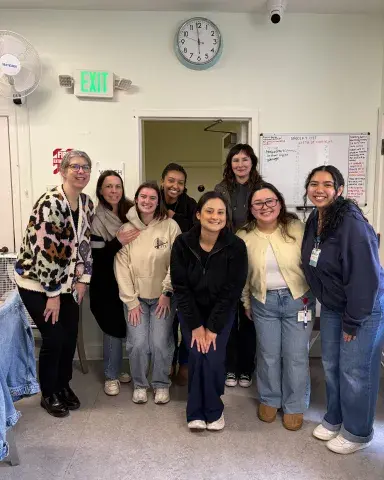
Operated by the Homeless Prenatal Program (HPP), Jelani House supports mothers from any stage of pregnancy through their infant’s first year, providing stable housing, emotional support, and a pathway to permanent housing. Now in her third year at the site, Proctor has led seven cohorts of nursing students through Jelani House for their clinical rotation.
Proctor has spent much of that time thinking carefully about what happens at the turn of each semester. When the semester ends, nursing students—who residents might have bonded with—leave, and a new group of students arrives. For residents who have lived through the trauma of housing instability, that cycle of disconnection can be burdensome, especially across the long gaps of summer and winter breaks.
To address this, Proctor developed the Care Ambassador program in partnership with HPP: a work-study role designed to maintain a steady, familiar presence at Jelani House year-round. She typically selects a case management student in their final pre-licensure semester, someone who can carry that presence forward even as they transition into their nursing career.
This year’s Care Ambassador is Tessa Jonoubeh, an Entry Level Master of Science in Nursing — Case Management (ELMSN-CM) student in her final year at SMU, who joins Proctor at Jelani House every Thursday. Jonoubeh’s role centers around building trust with residents, connecting them to resources, and bridging the gap between the healthcare system and community support they may struggle to access on their own. “My favorite part of this role is simply showing up and being present, offering a helping hand, listening, or sharing love in a space where mothers feel supported and valued,” Jonoubeh says.
Though Proctor is her professor and mentor, Proctor describes their dynamic as a genuine collaboration, one she learns from as much as she leads. Together, they stay attuned to what residents and staff need; Proctor knows that working alongside people in crisis every day takes a toll, and meaningful support should extend to the whole house, including the permanent staff. Jonoubeh serves as SMU’s steady point of connection for staff and residents alike.
Jonoubeh and Proctor share a bond over the importance of this type of holistic care for the mothers at Jelani House. “When we create that inclusive parallel environment where the students are down on the floor, holding babies, playing with the babies, relating to the moms, they don’t feel that otherness,” says Proctor. Jonoubeh finds the most rewarding part of her job being “the trust that develops over time.” It’s the kind of trust that, as Proctor puts it, “really helps to bring down their walls.”
B4 Project: Babies, Books, Blankets, Bonding
Hoping to expand her footprint at Jelani House, Proctor applied for the Beamer Award last year which would fund a project to further provide resources for mothers at Jelani House. Inspired by the importance of early childhood learning and a nostalgia for school book fairs, the B4 Project: Babies, Books, Blankets, and Bonding came to fruition.
Research shows that reading daily to infants as young as six months correlates with stronger vocabulary, cognition, and socioemotional development by their first birthday. The project brings that evidence to life through quarterly book fairs held in February, May, August, and November, where residents of Jelani House participate in a short workshop on reading promotion and local literacy resources, then select an age-appropriate book and a blanket to take home. Because many mothers stay at Jelani House for a year or more, they can return each quarter, receiving books that grow alongside their child’s development.
The first book fair, held this February and made possible by the Beamer Award, set the tone for what the project can be. Ten SMU nursing students joined Jonoubeh and Proctor to present on early childhood literacy, help mothers choose books, and spend time with the babies. The students researched and sourced additional resources to share with families, including the Dolly Parton Imagination Library, and coordinated donations of stuffed animals and blankets.
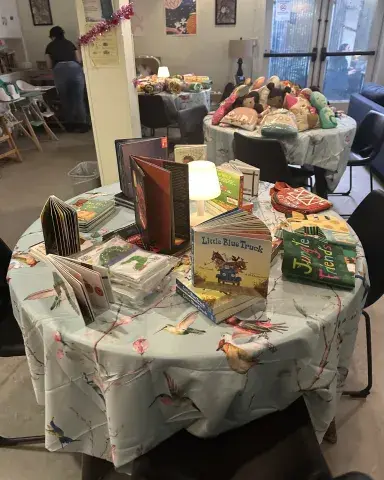
“All of the items were a hit,” said Proctor. She noticed the handmade dolls that resembled the residents went first, and the moon-shaped pillows doubled as tummy time supports. A notable moment for her was watching the mothers browse through the books and toys, discussing why they were drawn to particular ones. “I imagine in a situation where they might not have a choice,” she reflected, “every opportunity to create choice is empowering.”
An unexpected surprise was the partnership that emerged with Quilts for Kids, a nonprofit organization that handmakes and donates quilts for children in need. While researching resources for the event, Proctor found herself drawn into the history of quilting in America. “Instead of just a blanket, wouldn’t a beautiful quilt be better,” thought Proctor, “an heirloom item that would mark a time with the family, help protect and bring joy to them.” She envisions that the B4 project will give mothers a lasting memory. “That’s my hope for them, they’ll have something to keep.”
Jonoubeh echoed that sentiment, noting how meaningful it was to see how much these gifts mattered to the mothers. “These gifts represent more than just items,” she said. “They reflect the generosity and compassion of a community coming together to support mothers and their babies.” It’s that spirit of community, built through consistent presence and genuine care, that runs through everything Proctor and her students bring to Jelani House.
Underlying all of it is a belief that Proctor—also a midwife—has carried throughout her career. She approaches both birth and teaching as attending to people’s dreams. “A mother’s love for a child is transformative,” she says. “If anything is going to change, it is going to come from that place. Change comes from the family and the community.” It’s a perspective she works to instill in her students, many of whom carry their own stories similar to the mothers at Jelani House—stories of early teenage pregnancy or homelessness. They come to this cohort because they want to give back to the same situations that shaped them. “Almost like we are gardening in the same place,” Proctor reflects, “and making it better and better.” For her, that’s what makes the work at SMU so meaningful. “I really love the position I’m in,” she says, “because I get to know those stories.”