From Oakland Youth to Oakland Healthcare: Building Pathways into the Health Professions

For many young people, the path to a career in health care begins long before they submit a college application. It can start with a field trip to a university campus, a conversation with a nursing student, a first chance to practice a clinical skill, or a mentor who helps them imagine themselves in a profession they never thought possible.
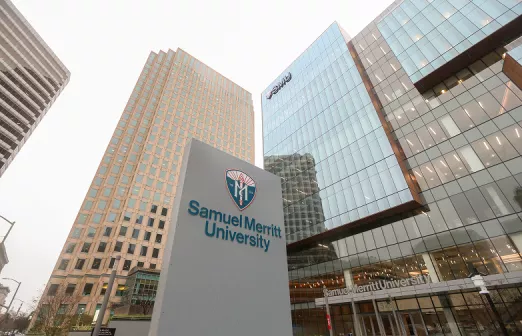
At Samuel Merritt University (SMU), those experiences are an important part of what it means to be rooted in Oakland.
Over the past five years, SMU has engaged nearly 6,000 youth in health career exploration through more than 150 events and field trips through programs led by the Center for Community Engagement (CCE) and Ethnic Health Institute (EHI), as well as through our support of other local organizations leading this type of work. It’s exciting to see this investment come full circle, with young people first introduced to healthcare through pathway programs supported by SMU now choosing SMU for their own health professions education.
Octavia Ontiveros, BSN '26, and Vinh Tran, ELMSN-FNP '28, are both Oakland Unified School District (OUSD) alumni whose early experiences with health career pathway programs helped shape their journeys to SMU. Today, both are preparing for careers that will let them give back to the communities that raised them.
"We often talk about pathway building programs as a community offering, and it absolutely is," says Dr. Sam Alavi, director of SMU's CCE and EHI. "But these programs also strengthen SMU. When we give youth from underrepresented backgrounds the opportunity to see themselves as future healthcare professionals and introduce them to SMU, we are building a network of future students who already understand our mission and our connection to this community."
Seeing Herself at SMU
Ontiveros, an Oakland native and first-generation college student, first encountered SMU while attending Oakland Technical High School. As president of the school's nursing club, she worked with SMU nursing students to organize panels for students interested in nursing. Through Oakland Tech's Health Academy, she also visited SMU's campus. "I remember feeling that I could see myself there," she recalls.
Moreover, through Community Health and Adolescent Mentoring Program for Success (CHAMPS), one of EHI’s community partners, Ontiveros worked alongside SMU students and faculty while she was still in high school, at EHI’s signature event, Hypertension & Wellness Sunday."Before I ever enrolled at SMU, I was already learning from the people who would help shape the nurse and community advocate I am becoming today," she says.
Coming full circle, as a student employee of the CCE and EHI, Ontiveros supports many of the University’s community health and pathway-building programs. Most recently, she helped lead workshops on birth work careers, IV insertion, Narcan administration, and career navigation through the CCE/EHI’s Strengthening Opportunities in Advancing Regional Healthcare (SOAR) summer internship program for East Oakland youth. When she talks to the youth, she offers them something particularly powerful: the opportunity to meet someone who was once in their position.
A Path Shaped by Mentorship
For Tran, the pathway to SMU was not linear. While a student at Oakland’s Life Academy High School, he participated in the FACES for the Future program, founded and directed by SMU faculty member Dr. Tomás Magaña. For more than two decades, FACES has helped young people explore health careers through mentorship, hands-on learning, and clinical exposure. SMU has partnered with FACES for over a decade, including hosting the organization’s Summer Medical Academy students on its Oakland campus. Through FACES, Tran began becoming excited about a career in healthcare.
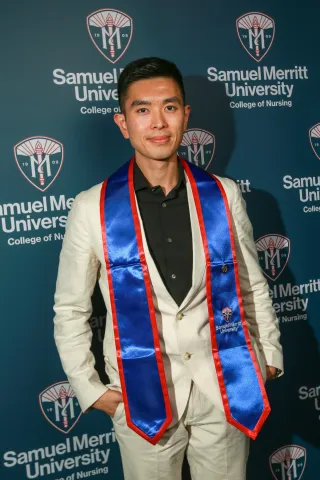
College, however, proved difficult. Tran struggled academically, as he found himself far away from his Oakland support system, navigating the many obstacles that come with being a first-generation college student. Tran credits Dr. Magaña’s continued mentorship, even beyond his time at FACES, with helping him reconsider what was possible and ultimately find his way to SMU. Today, Tran is thriving academically while staying true to his values of community service by tutoring, serving as a teaching assistant, and working at Oakland’s Asian Health Center (AHS) while finishing his degree.
“Having witnessed his journey from his early years in FACES to his pursuit of a nursing degree at Samuel Merritt University, I am especially proud of his growth and accomplishments. Vinh embodies what we hope to inspire in every FACES student: the confidence to dream, the resilience to persevere, and the determination to turn aspirations into reality,” Magaña reflects. “For FACES and our educational partners like SMU, Vinh's accomplishments represent the realization of our shared mission and the power of sustained investment in young people. His success is not simply an individual achievement; it reflects [our] collective impact.”
When Tran began researching SMU as a prospective student, its Oakland roots mattered. "I looked at the mission statements and... it matched my own personal statement," he says of his decision to apply. His connection to Oakland continues to shape the kind of provider he hopes to be. Tran, who immigrated from Vietnam and attended high school in Oakland, said his language skills and lived experience help him relate to patients, particularly in the area's immigrant communities. He now commutes back to Oakland several times a week to work at AHS, despite currently living in Sacramento.
His experience also demonstrates why sustained mentorship matters. Near the end of his interview, Tran reflected on the impact of the people who supported him along the way. "People can inspire you to work hard," he says, "but at the end of the day, those who inspire you to give back [are] more powerful." The CCE/EHI strives to foster that same spirit of service in current and future students.
Building Pathways That Return to Oakland
“Pathway building programs like the ones we have at SMU help expose underrepresented youth to different types of healthcare careers, while also giving them tangible tools they can bring back to their communities around health advocacy”, says Allyson Emmarene, the CCE/EHI’s Program Manager for Pathway Initiatives & Community Engagement.
They also create a tangible pathway into the University itself. "When we talk about enrollment, workforce development and community engagement, we shouldn't think of them as separate goals," Emmarene says. "Octavia [Ontiveros] and Vinh [Tran] show what happens when those pieces connect.”
That cycle matters, especially in Oakland, where SMU has educated health professionals for more than a century, and healthcare worker shortages remain a pressing issue. Ontiveros describes her own journey as coming "full circle," from an Oakland high school student learning about nursing from SMU students, to being a nursing student herself helping other young people explore the same path. She hopes eventually to become a doctorally prepared midwife and open a birth center and women's health clinic serving families, particularly those who have historically been overlooked or underserved.
Her story, like Tran's, illustrates the long-term return on an investment that may begin with something as simple as a field trip. "SMU being rooted in Oakland involves more than just having a building downtown," Alavi says. "It means creating opportunities for Oakland's youth to see themselves at places like SMU, supporting them as they pursue those goals, and helping them bring their skills and leadership back into the community."
“Partnerships between organizations like FACES and health sciences institutions like SMU are essential because they help create a continuum of support that extends from early career exploration through professional education and beyond. FACES provides critical early exposure to healthcare careers, experiential learning, academic enrichment, and mentorship that help young people discover their potential, develop confidence, and establish professional aspirations. Institutions like SMU build upon that foundation by providing access to advanced education, professional training, mentorship, and opportunities for career advancement,” explains Magaña. “Ultimately, Vinh’s success demonstrates what becomes possible when institutions make a long-term, collective commitment to investing in the potential of young people.”
For some youth, a field trip to SMU, a summer with the FACES Summer Medical Academy, or mentorship from students and faculty may ignite interest in pursuing a healthcare career. For SMU students like Ontiveros and Tran, it became a pathway home.
Learn more about SMU’s Pathway Building Programs in the CCE 5 year Report.
Learn more about FACES for the Future.