SMU Students Support Oakland Youth Athletes at Marshawn Lynch’s Fam 1st Foundation Football Camp

SMU Students and NFL Greats Visit Oakland Technical High School
On Saturday, July 11 Samuel Merritt University (SMU) physical therapy, occupational therapy, and podiatry students headed to Oakland Technical High School to serve as an on-site sports medicine resource for the Fam 1st Football Camp. They put their classroom skills to work on the field, sharing the day with NFL greats Marshawn Lynch, Josh Johnson, and Marcus Peters.
The event marked the 20th anniversary of the Fam 1st Foundation's football camp, held in partnership with the Oakland Athletic League. SMU students were on hand to offer their services — from knee and ankle exams to taping up athletes who needed it.
The day laid the groundwork for a long-term relationship with the broader Oakland athletics community.
"I think it's very important for people to know that we're here for them, even for minor injuries," says Khushi Patel, a second-year podiatry student. Though Patel and her classmates haven't yet taken their biomechanics class, she reflected, "I think it's really nice to be here and be there for [the athletes] in any way."
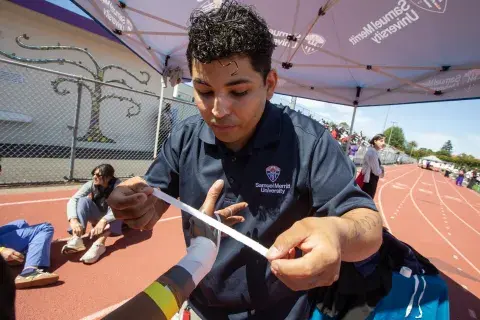
The event was just as exciting for SMU staff. "I think this was a really good look, initially, at what SMU supporting Oakland young athletes looks like," says Monica Uriarte, who served as SMU’s Director of Corporate and Foundation Relations and was instrumental in launching the partnership. "There's just so much opportunity in this space, both from a youth development and a sports medicine perspective. Our students need practice, Oakland needs the help. Let's match them together and make something happen."
Broader Importance of Sports Partnerships
From a broader view, the new partnership opens up longer-term opportunities to build workforce and education pathways for Oakland youth interested in health careers. There's strong enthusiasm among SMU students, faculty, and staff around possibilities like career exposure, on-campus experiences, continued participation in Oakland Athletic League events, scholarship pathways, and other initiatives that could support students while strengthening the future healthcare workforce.
For Aisha Watt, a second-year physical therapy student, "sports partnerships are important for students who are interested in maybe going down a sports path, like I am." For her, these outreach opportunities reduce the stress of needing to build connections in the field post-grad.
Events like this also bridge the gap between programs, bringing together students who might not otherwise interact — something Watt noticed right away. "We talk about interdisciplinary skills in PT school, how you're going to work with other doctors, occupational therapists. This is us," she says, gesturing to the students around her. "There are OTs here. There are podiatry students here. This has been a good lesson in collaboration."
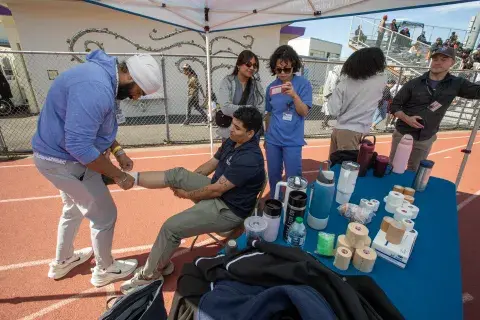
Uriarte agrees that one of the most valuable — and often unseen — parts of sports partnerships is this cross-collaboration between programs. She points to SMU Oakland's Motion Analysis Research Center (MARC) as a prime example. "It doesn't just serve podiatry; it also serves PT, it serves OT, and it could incorporate nursing. And I think the important part about sports is they need all of that wrapped into sports medicine in order to be successful." Medicine, she reflects, is not insular.
To Uriarte, Oakland's identity as a sports town makes this work especially meaningful. "Oakland is a sports town… there's been so much energy in the last year or two around reestablishing sports and sports agencies. You have the Roots, you have the Ballers, Marshawn [Lynch] is from here," she explains. "Our students have a place in the Oakland community, and exercising that through sports is a really important way to do it."
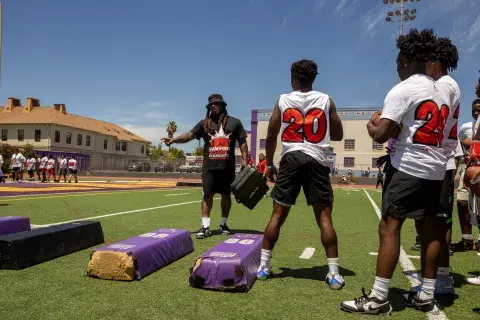
Watt sees the partnership as a two-way benefit — growing her own skills while giving back. It's a way, she says, to "give back to the community and get [athletes] connected with people that can really give them some valuable care."
What excites Uriarte most is the potential for SMU's presence to fill a real gap: Oakland's middle and high school athletics programs don't have access to athletic trainers for all their sports, or nurses on the field. "Our students could provide some of that at football games, at soccer games, at all of those things."
"What Josh Johnson and I have talked about pretty in depth," Uriarte explains, "is that a reason Oakland hasn't produced elite-level athletes in the last few years is because there is this lack of resources around health and biomechanics [analysis]. So I think that's why it's important to do it now — why we have all the resources, we have all the students. Why wouldn't we do it now?"
She also sees room to grow the model beyond Oakland — replicating it in cities like Sacramento, Fresno, or Foster City, home to SMU’s other campuses, or extending it to professional sports teams. Saturday was just the beginning. As SMU and Oakland's athletics community build on this partnership, both sides see the same thing: a chance to strengthen student training and community care together.