SMU’s San Francisco Peninsula Campus Opens Doors at New Foster City Location

New San Francisco Peninsula Campus Opens in Foster City
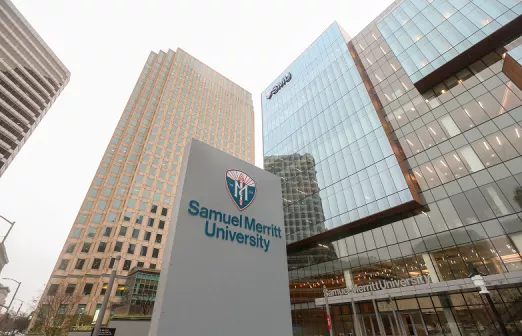
Last week marked a new chapter for Samuel Merritt University (SMU) as students, faculty, and staff began classes at the University’s newly relocated San Francisco Peninsula (SFP) campus in Foster City. Formerly based in San Mateo, the campus has moved into a newer building designed to better reflect SMU’s student-centered mission and growing programs.
The new San Francisco Peninsula campus occupies the entire first floor of its building in Foster City, offering a significant space increase and facilities upgrade from the previous San Mateo location. Where the former site had limited interior room and outdoor spaces for students to gather and study together, the new campus was designed with collaboration and community in mind.
The interiors are modeled after the newly opened SMU Oakland campus, creating a cohesive, modern look across locations. The campus features three large classrooms, a computer lab, expanded simulation spaces including two skilled nursing simulation labs, standardized patient rooms, and control rooms. In addition, the campus offers spaces for student-focused amenities such as a pantry, library, student lounge, wellness room, testing room, lactation room, and conference rooms.
Beyond the building itself, the campus is situated in a scenic area of the city. Directly across the street is Leo J. Ryan Park with green space, a lake, walking trails, boating, and pickleball courts. The area also offers convenient access to a diverse mix of retail and dining options, all within walking distance or a short drive.

Student, Faculty, and Staff Reflections
For faculty and staff, the move represents more than a change in address; it reflects a deeper commitment to student experience.
Michael Wong, Assistant Dean of Students for Campus Life at the SFP campus, describes the new space as intentionally student-centered. “It would be easy and obvious to say that there are more and bigger student spaces,” Wong said. “But diving deeper, there are multi-use spaces that our ABSN students can study, socialize, and enjoy in between classes, labs, and simulations.”
He points to Suite 120 as an example of how the campus adapts to the pace of the Accelerated Bachelor of Science in Nursing (ABSN) program. In the early morning, the suite functions as a study space for students to review before exams. By midday, it becomes a gathering place for lunch, and in the evening, it transforms again into a quiet study room for students to wait out traffic before heading home.
“For ABSN students in particular, having spaces designed to meet multiple needs and match the pace and intensity of the program makes a meaningful difference,” Wong said.

Haley Koning, ABSN Program Director at the SFP campus, describes the new campus as beautiful. “It is spacious, and there’s so much light everywhere,” she said. “I’ve been really enjoying watching the students come in and kind of light up as they see the new space.” For Koning, the upgrade is not just about aesthetics—it’s about affirming that students deserve a high-quality learning environment.
For students, the difference between the former San Mateo site and the new Foster City campus is immediately visible.
Daniel Wray, an ABSN student at the SFP campus, describes the new campus as welcoming and energizing. “I think it’s amazing. It’s friendly for all the students,” he reflected. “I’m most interested in the nursing facility where you can work on your skills, your head-to-toe assessment. It’s just a lot of lighting and positive energy.” He noted that the previous campus, located on the third floor of a building, felt smaller and offered fewer places for students to gather.
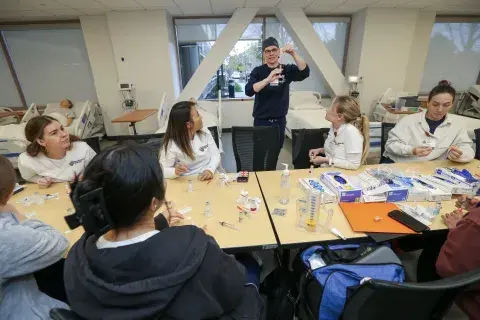
Fellow ABSN student, Shristi Aryal, said she was struck by how bright and open the new campus feels, noting the larger windows and abundance of natural light. She recalled learning in the nursing program that light can have a significant impact on mental health, something she now sees reflected in her own classroom experience.
Aryal believes the new campus provides a greater sense of security and belonging. Unlike the more secluded previous site, the Foster City location feels lively and “more like a university,” she remarked.
Looking Forward at the SFP Campus
The first week brought encouraging signs. Wong noted how naturally students gathered in shared spaces and engaged in passive programming activities. Looking ahead, he hopes to build on that momentum by creating more opportunities for connection outside the classroom.
“A lot happens in a year,” he said of the ABSN program. “We get to witness informal peer support, student-led activities, life milestones, birthdays, holidays, celebrations, and so much more. My hope is the campus gives everyone an opportunity to not only be in a program, but to cultivate a stronger sense of belonging and identity to SMU.”
Koning and Wong have embraced the theme of “Transforming Together” for 2026, a concept that reflects growth across the campus community. “This space is kind of the beacon of that,” Koning said. “We are transforming the campus, the faculty, the students, and we’re really excited about it.”