

University Facilities
Campus Locations
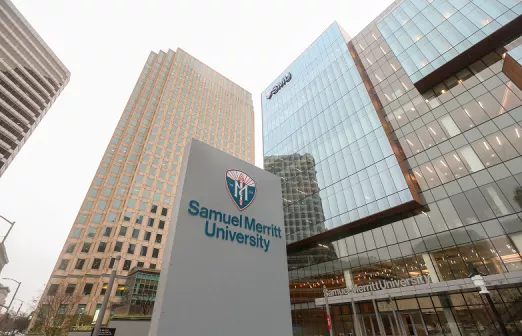
Oakland Campus
525 12th Street, Oakland, CA 94607
The Oakland campus is comprised of 10 floors.
- 255,000 sq. ft.
SF Peninsula Campus
989 E Hillsdale Blvd, Foster City, CA 94404
The Foster City campus is comprised of 2 floors.
- 21,334 sq. ft.
Sacramento Campus
2710 N. Gateway Oaks Drive Suite 360, Sacramento, CA 95833
The Sacramento campus is comprised of 2 floors.
- 39,761 sq. ft.
Fresno Campus
1791 E Fir Ave, Fresno, CA 93720
The Fresno campus is comprised of 2 floors.
- 27,871 sq. ft.
Campus Labs
OAKLAND CAMPUS
Motion Analysis Research Center (MARC)
The Motion Analysis Research Center is a state-of-the-art laboratory dedicated to advancing the study of human movement and biomechanics through education, interdisciplinary research, and clinical practice. The 2,350-square-foot facility is the only motion lab in the Bay Area shared by healthcare experts from a variety of disciplines to study human movement and performance. SMU faculty and students use the MARC to study biomechanics, balance, gait, upper and lower body movement, and the effect of clinical pathologies, clinical intervention methods, assistive devices, athletic training, and wearable technologies—valuable objective quantitative information to guide evidence-based client services and patient care.
The MARC features cutting edge systems to measure three-dimensional motion of the body and joints, forces, pressures, balance, strength, and muscle function. These insights equip students, faculty, and clinical researchers to evaluate new approaches, enhance evidence-based practice, and advance care that supports mobility, independence, and quality of life.
The facility offers an exceptional environment for hands-on interdisciplinary learning, faculty mentorship, and meaningful research for students and faculty in the SMU College of Podiatric Medicine, Department of Occupational Therapy, Department of Physical Therapy, and College of Nursing, as well as collaboration with UC Berkeley Engineering and industry partners.
Research, Autoclave & Podiatry Support Labs
These labs provide new capabilities for having a microbiology lab in which research in cell biology, physiology, immunology, genetics, and microbiology can occur. The spaces will initially be used by podiatric cohorts and eventually for biomedical sciences cohorts, as well as expand SMU’s research capabilities. The Podiatry Support Lab allows podiatric students and faculty to work safely with foot and ankle specimens and practice surgical procedures.
Human Motion and Therapeutics Labs
The Human Motion Lab, used by the Physical Therapy and Occupational Therapy programs, has 15 wide-width hi-low treatment tables for skills practice for patients with neuromuscular movement dysfunction. The Therapeutics Lab has 25 hi-low treatment tables for skills practice of musculoskeletal assessments and treatment techniques. The labs are equipped with physical agent and electrotherapeutic machines, therapeutic exercise equipment, crutches, walkers, wheelchairs, floor mats, and free weights.
Community Participant Lab
A shared lab space for the Physical Therapy and Occupational Therapy programs, this lab features a treatment table, treadmill, parallel bars, training stairs, and a private briefing room for use during our Community Participant Labs. Community Participant Labs are opportunities for students (under faculty supervision) to work with community members needing rehabilitation services.
Biomechanics & Podiatry Clinical Labs
In the Biomechanics Lab, students are taught lower extremity biomechanics and learn to take negative casts of or scan feet prior to fabricating orthotics. The Podiatry Clinical Lab is used for teaching physical examination skills, hands-on diagnostic ultrasound, and other clinical skills.
Living Skills Lab
This occupational therapy lab includes a working kitchen, laundry area, and a home-like bathroom with tub for practice and training in activities-in-daily-living interventions.
Orthotics Lab
This occupational therapy space includes hi-low treatment mats and heavy worktables for therapeutic activities, activities-in-daily-living, and adaptive device use and development. The lab will also be used for training in splint fabrication and physical agent modalities, such as heat/cold, paraffin wax, fluidotherapy and more.
Pediatrics Lab
The occupational therapy pediatrics lab contains sensory and therapeutic equipment to use with clients in our Pediatric Community Participant Lab. The adjoining observation room allows faculty to observe student and pediatric client interactions.
Anatomy Lab & Virtual Anatomy Lab
The Anatomy Lab serves as a shared learning environment for students across multiple programs. The lab is approximately 3,390 square feet and features stainless steel anatomical dissection cadaver tables, metal stools, sinks for handwashing, and cabinets for storage of dissection equipment and specimens. Equipment in the lab includes hanging skeletons, disarticulated skeletons (bone boxes), spine models, and various joint models. Monitors throughout the space allowing students to view faculty demonstrations from any point in the lab.
The Virtual Anatomy Lab uses virtual reality, augmented reality, and 3D models and will bridge instruction and learning between these different and cutting-edge modalities. The 2,725 square foot lab is equipped with 28 immersive virtual reality headsets. Students are invited to use VR to explore the anatomy of complex structures that are difficult to comprehend through more traditional methods. Students can also study anatomical models and osteological specimens in the lab.
Health Sciences Simulation Center (HSSC)
The Samuel Merritt University Health Sciences Simulation Center (HSSC) provides innovative, experiential learning environments that prepare students for the complexities of modern healthcare practice. The HSSC is accredited by the Society for Simulation in Healthcare (SSH) in the areas of Teaching/Education, Assessment, and Research, a distinction that recognizes excellence and adherence to internationally recognized standards in simulation-based healthcare education. Simulation-based learning is integrated throughout the curricula of all Samuel Merritt University programs and supports both discipline-specific and interprofessional learning experiences across all campuses.
Healthcare simulation is a teaching method that allows students to practice caring for patients in realistic clinical situations before working with actual patients. Similar to how pilots use flight simulators to prepare for real-world scenarios, healthcare students learn and refine their skills in safe, controlled environments. Using lifelike patient simulators, trained actors portraying patients, contemporary medical equipment, and realistic clinical settings, students develop clinical skills, decision-making abilities, communication techniques, and teamwork competencies while building confidence without risk to patient safety.
Each SMU campus features dedicated simulation facilities designed to replicate real-world clinical environments. These learning spaces are supported by experienced simulation faculty and staff who partner with academic programs to implement evidence-based educational practices and create meaningful, hands-on learning opportunities.
Through simulation, students develop and demonstrate clinical competence before caring for actual patients. Learners gain experience performing technical procedures, applying clinical reasoning, prioritizing patient care, and responding to complex healthcare situations. Advanced audio-video technology captures simulation activities, enabling guided debriefing sessions where students reflect on their performance, strengthen clinical judgment, and deepen their learning.
Patient safety is a foundational principle of all simulation experiences at SMU. Learning activities are intentionally designed to foster effective communication, teamwork, and collaborative decision-making, reflecting the realities of contemporary healthcare practice. The HSSC plays a central role in the University's interprofessional education initiatives, bringing together students from multiple health professions to learn with, from, and about one another. TeamSTEPPS® tools and strategies are incorporated throughout simulation activities to promote high-reliability teamwork and a culture of patient safety.
SMU's simulation centers are equipped with advanced healthcare simulation technology, including Laerdal® patient simulators such as SimMan® Essential, SimMan® 3G, SimBaby®, SimNewB™, and SimPad®-compatible manikins. The University also maintains a comprehensive inventory of task trainers ranging from foundational skills models to highly sophisticated patient simulators, including Harvey®, the renowned cardiopulmonary patient simulator. In addition, the HSSC coordinates a network of more than 100 trained Simulated Participants (SPs) who enhance learning experiences across all campuses by portraying realistic patient encounters and supporting assessment activities.
All simulation environments are equipped with contemporary medical equipment and supplies that mirror current clinical practice. Through its SSH-accredited programs, advanced technology, experienced faculty and staff, and commitment to patient safety, the HSSC provides students with authentic learning experiences that build the confidence, competence, and collaborative skills needed to deliver high-quality patient care and succeed in today's healthcare environments.
OAKLAND CAMPUS
The HSSC on the Oakland campus is comprised of over 40,000 square feet.
This includes 4 large multi-disciplinary training rooms equipped with gurneys, patient beds and standard equipment required to learn and practice health assessment/physical exams and a wide range of clinical skills. All rooms/suites are equipped to implement and record any type of simulation technique, as well as support most methods of technology-enhanced teaching. In addition, there are 6 standardized patient rooms, 2 home health labs, and a podiatry surgical skills lab. The Meds Room, Nourishment Alcove, and Nursing Alcoves are located near the training rooms.
The HSSC has 6 simulation rooms and 2 simulation suites with adjoining observation rooms for faculty evaluations of student skills activities. There are 16 clinical exam rooms and a Meds room on this level. Six debrief rooms provide space for students to gather to observe in real time and to reflect on the simulation experience.
A major feature of the HSSC is its digital audio-video system and performance assessment software provided by Education Management Solutions, Inc. (EMS). Technology and software applications work in tandem to record simulation scenarios/encounters, enabling program faculty to critique/evaluate the performance of the students. Students also have opportunities to review their own recordings for the purpose of self-assessment and reflection. It is the EMS software that enables the immediate review of patient care scenarios during debriefing sessions, a critical component of simulation-based learning.
SAN FRANCISCO PENINSULA CAMPUS
The approximately 5,300 square foot area includes 2 large skill labs with patient beds and standard equipment required to learn and practice health assessment/physical exams and a wide range of clinical skills. In addition, this facility has 3 clinical exam rooms. Each training and patient room is equipped to implement and record any type of simulation technique, as well as support most methods of technology-enhanced teaching.
SACRAMENTO AND FRESNO CAMPUSES
Each campus has approximately 4,000 square feet dedicated to simulation. The space includes 2 large skill labs, 6 clinical exam suites, 2 large simulation suites, and 2 debriefing rooms. The facility includes the same audio-video capability as described on the Oakland campus.
Libraries
John A. Graziano Memorial Library
The John. A Graziano Memorial Library houses the largest and most complete collection of nursing journals, monographs, and audiovisual materials in the East Bay, and one of the best collections in this specialty area in California. The Library also has holdings in physical therapy, occupational therapy, physician assistant, and podiatric medicine resources. In addition, the Library supports a core medical collection of textbooks and reference materials and subscribes to more than 10,000 print and electronic journals. The Library currently contains a collection of 46,000 volumes. The Library maintains online access to 33 databases of allied health literature and supporting specialties. In addition, there are laptop computers with network access available for in-library usage. The Library is the information center for Samuel Merritt University. As such, it serves the students, faculty, and staff with a full range of reference and circulation services and full access to electronic information technology. Members of the University community may be asked to present their photo identification card to assure access to library collections and services.
Library Facilities and Services at the Campuses
Students and faculty at the campuses have the services of a librarian who can assist you to find information and utilize the online resources. The librarian provides orientations to library services and teaches students how to locate, evaluate, and effectively use the needed information. The librarian also works with faculty to build core text collections that support the curriculum. Students are encouraged to set up appointments to work with the librarian one on one or in small groups, especially if they would like to be seen in person.
All Library licensed databases, including electronic journals and e-books are available at the campuses. Proxy mediated access to databases is also available from off campus.
Services & Amenities
OAKLAND CAMPUS
Bike Storage
A badge-access bike storage room, with a capacity to store around 100 bikes, is located on the basement level. Lockers, changing areas, and showers are available in the nearby bathroom suites.
Campus Bookstore and Spirit Store
The Campus Bookstore and Spirit Store is located next to the Campus Café. The store offers a variety of supplies and SMU branded items for purchase.
Campus Café
The Campus Café on the ground floor serves delicious and healthy breakfast and lunch options, with grab and go snacks available all day.
Lactation Rooms
Lactation rooms are located on levels 5, 7, and 9. Each room is equipped with comfortable seating, a sink and small refrigerator.
Lockers
Lockers are available for students at no cost throughout the campus. Lockers are located on the levels 4, 5, 6, 7, and in the basement locker room. Lockers are for DAY use only.
Lost and Found
Lost and found services are available at the University reception area on the first floor.
Lounges and Collaboration Spaces
Lounges are located on most floors throughout the campus for students to study and socialize. All students must clean up after themselves and report damage or safety hazards when using these areas.
Multipurpose Wellness Room and Meditation Rooms
The campus has two larger multipurpose wellness rooms for group health-related activities, exercise classes, or workshops to support student wellbeing. These are located on the first and second floors. In addition, there are individual meditation rooms, equipped with comfortable seating, on floors 4 and 8.
Student Services
All student services (Student Health & Counseling, Academic Support Center, Disability Resource Center, Student Pantry, SMU Central, Admissions, and Disability Resource Center) are centrally located on the second floor.