In Her Own Words: Rondi Crowley on a Life Dedicated to Nursing

With more than four decades of experience in nursing, Rondi Crowley, RN, has done it all—from staff nurse to operating room director. A Samuel Merritt University (SMU) alumna, what started as a summer of volunteering blossomed into a remarkable 43-year career. She shares her journey, the rewards of the profession, and the advice she’d pass on to the next generation of nurses.
How did you land on a career in nursing?
In the summer of 1967, I caught a glimpse of what it would be like to work in a hospital. While finishing my junior year in high school, I decided to volunteer to be a candy striper at Alta Bates hospital in Berkeley. My sister, who was in nursing school at the time, was home for the summer and working as a nurse's aide at the same hospital.
Up until that point I thought I wanted to be a PE teacher, but that summer changed my mind. At the start of my senior year, I applied for the diploma program at Samuel Merritt Hospital (SMH). When I received the acceptance letter, I was so excited but petrified at the same time.
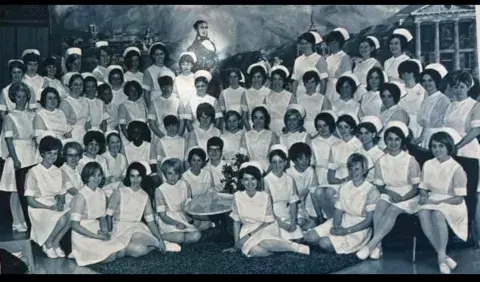
I loved the atmosphere at SMH—the dorm life, the instructors—but most of all, I loved the hands-on experience we received right from the beginning. After finishing our first quarter, we were qualified to become nursing aides in the hospital. During my junior year I experienced a taste of the operating room during my surgical rotation. I learned the names of instruments, how to scrub, gown and glove and was even required to scrub on cases and pass instruments. This is where I fell in love with surgery.
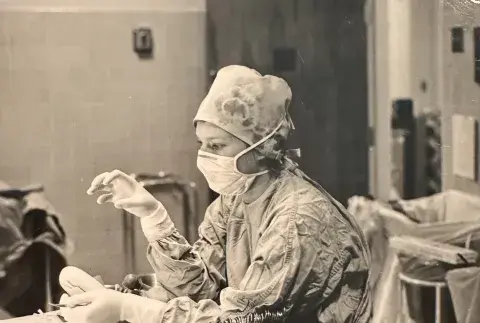
I applied and was accepted into SMH’s advanced surgery training program for students pursuing a career in the operating room. We were paired with a mentor and worked weekends and summers until we graduated. Moe, my mentor in the program, taught me the basics on how to scrub on cases. She was as tough as they came, like a drill sergeant, and expected perfection, but she was the best. By the time I graduated from nursing school, I had the foundational knowledge and experience to be a qualified operating room RN.
A fellow classmate, Donna Benotti, and I were in the program together. After graduation, Donna continued to work at SMU for the next four decades and was an outstanding mentor in her role as the perioperative educator.
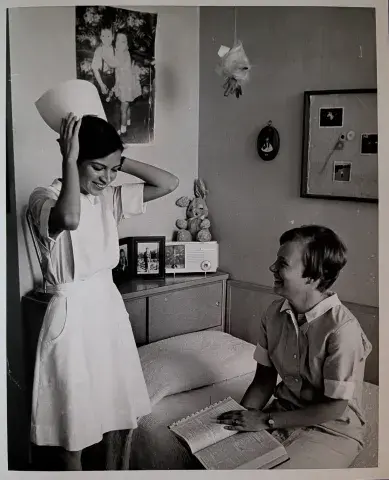
After graduation, I worked at SMH for two years before moving to Stanford Hospital in Palo Alto, where I completed various specialty rotations. In 1975, my husband and I relocated to Sacramento, and I joined the surgery department at Methodist Hospital as a staff nurse. Over the next 35 years, I advanced through the ranks, ultimately becoming Director of the Surgery Department.
I finished my career as the Bariatric Program Manager until I retired in 2018 after 43 years at Methodist Hospital. Becoming a nurse was the best decision I’ve ever made, and I continue to keep my RN license current.
What have you found most valuable about being a nurse?
Nursing allows for a wide variety of job opportunities. If you are working in a department that doesn’t seem to be a good fit, you can look for another department, another hospital, a clinic, an insurance company, a law office or public health. You can work in a rural clinic or at a University Medical Center. The choices are endless.
However, the best part of being a nurse is taking care of people. You often see patients in their most vulnerable state—an accident or a diagnosis may have just altered their life. Physicians are the driver of the patient's care but you, as a nurse, are the go between.
You go between the patient and their family, physicians, clergy, and friends. You notice subtle changes in a patient's condition and make note of it. You might react to a code blue situation one minute and a patient transitioning to hospice care the next, each demanding a completely different emotional and professional response.
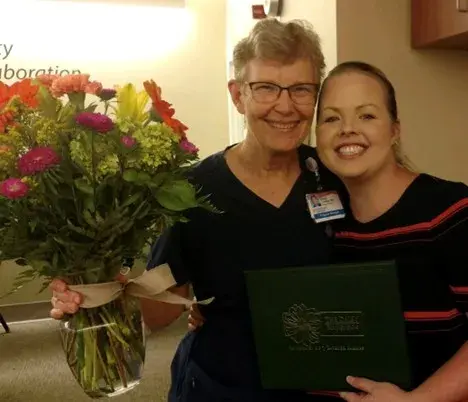
What advice would you give to new nurses entering the field?
The best advice I received from one of my instructors early on was to take time to listen to what the patient is telling you. Be hands on and look for important clues that may be subtle and possibly overlooked. If you sense something is not right with a patient, say something. So often the nurse is the one who picks up a subtle change that could save a patient's life. Listen to other caregivers if they have a concern. It’s a team effort.
I would give two pieces of advice to new nurses. The first is to listen to your mentors and preceptors, take notes, study, and ask questions. When you graduate, it is just the starting point of your career; there is still so much to learn. Notice what makes a good mentor, and emulate that when you become a mentor. Secondly, remember that healthcare is always changing; don’t be afraid to embrace those changes.